
More languages
More actions
Introduction
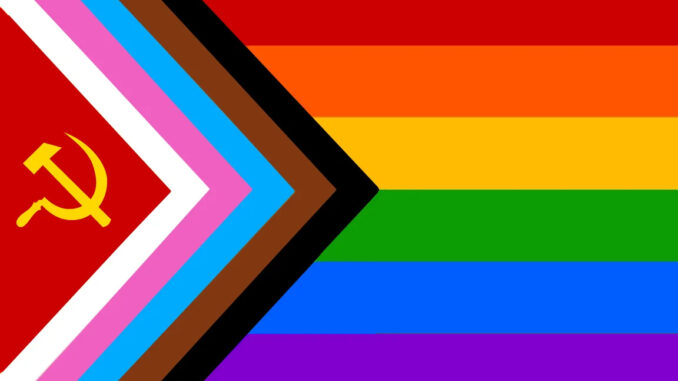
LGBTQ+ is an acronym used to denote the various different types of people that belong to the queer community; that is, people who either do not identify as heterosexual, cisgender, or neither. This community encompasses a wide range of different sexualities, genders and identities, and many people in the community either take on multiple identities or have their identities change over time.
Still new to this topic?
Check out some books on LGBTQ+ topics in our library!
ProleWiki also hosts Essays about LGBTQ+ topics written by its editors!
Check them out here.
The Fundamentals
Get acquainted with basic terminology such as
- Sexuality,
- Gender and
- Biological Sex
- Intersectionality
and afterwards - Marxism and
- Dialectical materialism
to tie LGBT+ struggle together with class struggle.
Distinctions
LGBT+ individuals go against the socially constructed norm in these categories:
Sexuality
- Homosexuality
- And their counterpart Heterosexuality
Gender
- Transgender People
- And their counterpart Cisgender People
Sex
Library works
We highly recommend the following authors, who have written extensively on LGBTQ+ topics:
Ideological currents concerning LGBTQ+ people
People

There have been many influencial personalities within the LGBTQ+ community and in their struggle for liberation. Some of them are listed here
Pictures
-

Bandstand at Ciutadella Park
-
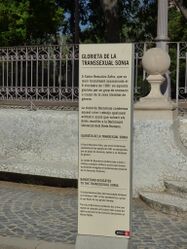
Plaque at the bandstand commemorating Sonia Rescalvo Zafra from 2013 to 2021.
-

Authorities and trans rights activists revealing the new Plaça Sonia Rescalvo Zafra sign in Barcelona on October 6, 2021


Current Events
From PinkNews (will redirect you to their website)
- 2026-03-10 Trump vows not sign any bills until act with anti-trans provisions is passed
- 2026-03-09 New Hampshire trans bathroom ban bill includes threat of prison time
- 2026-03-09 Jazz Jennings’ dad break down in tears over trans sports ban in moving video
- 2026-03-06 Kristi Noem: Her most controversial and cruel comments
- 2026-03-10 Olympian Colin Jackson tells other gay athletes not to be ‘fearful’ of coming out
- 2026-03-10 GB News whines that brands are ‘scared’ of advertising with them
- 2026-03-09 Olly Alexander calls out ‘spineless’ Labour government over anti-trans rhetoric
- 2026-03-09 Gay-for-pay OnlyFans star chained to Sussex housewife 24 hours a day in Channel 4’s Handcuffed
- 2026-03-09 Here’s why Pornhub is blocked for users in Australia right now
- 2026-03-04 Whitewashing, influencers and gay death penalty: Dubai was never a ‘safe’ place
- 2026-03-02 Woman jailed for wearing ‘Allah is a lesbian’ T-shirt faces arm amputation
- 2026-02-26 Lesbian group claim they have legal right to exclude trans women, to prevent discrimination
Historical Events
LGBTQ+ by country
Formerly existing Socialism
.svg)


Today's existing Socialism
See our page on LGBT rights and issues in AES countries


A through C
| Term | Definition | Example | See also |
|---|---|---|---|
| Abbreviation | A sequence of words is reduced to their first letters. | USSR, laser | Word-formation, acronym, initialism |
| Ablaut | The inflectional marking of the preterite or other verb tenses is realized through change of the root vowel. Ablaut patterns consitute allomorphs of the regular -ed inflection in English. | sing, sang, sung | Allomorph, preterite, root morpheme, tense |
| Accent | |||
| Accomodation | |||
| Accusative case | Signals the direct object of a transitive verb. | She kissed her. You wrote a new essay? | Direct object, transitive verb |
| Acronym | Abbreviation that can be pronounced as one word. | NATO, NASA | Initialism, lexeme, non-additive word-formation |
| Additive word-formation process | |||
| Adjective | |||
| Adjective phrase | |||
| Adjunct | |||
| Adverb | A word class that modifies the main verb of a clause in a way that adds context. | She quickly realized that... | Circumstance adverb, clause, degree adverb, sentence adverb, word class |
| Adverb phrase | |||
| Adverbial phrase | |||
| Adverbial participle | |||
| Affix | |||
| Age | |||
| Agreement | |||
| Allomorph | |||
| Allomorphy | |||
| Allophone | |||
| Ambiguity | |||
| Antonyms | |||
| Antonymy | |||
| Arbitrariness | |||
| Assertive speech act | |||
| Aspect | |||
| Assimilation | |||
| Attributive adjective | |||
| Auxiliary verb | |||
| Background knowledge | |||
| Base | |||
| Blending | |||
| Borrowing | |||
| Bound morpheme | |||
| Case | |||
| Categorization | |||
| Classical theory of Categorization | |||
| Clause | |||
| Clause pattern | |||
| Cleft construction | |||
| Cleft test | |||
| Clipping | |||
| Closed word class | |||
| Co-hyponyms | |||
| Collocation | |||
| Commissive speech act | |||
| Comparative linguistics | |||
| Complement (1) | |||
| Complement (2) | |||
| Complementaries | |||
| Complementarity | |||
| Complement clause | |||
| Complementary distribution | |||
| Complex linguistic expression | |||
| Complex sentence | |||
| Compositionality | |||
| Compounding | |||
| Concept | |||
| Concordance | |||
| Conjunction | |||
| Connotation | |||
| Consonant | |||
| Consituent | |||
| Content word | |||
| Contradiction | |||
| Contraction | |||
| Contrast test | |||
| Conventionality | |||
| Conversational implicature | |||
| Converse relation | |||
| Converses | |||
| Conversion | |||
| Cooperative principle | |||
| Coordination | |||
| Copula | |||
| Corpus (pl. Corpora) | |||
| Count noun | |||
| Covert prestige | |||
| Creativity | |||
| Cultural transmission |
D through F
| Term | Definition | Example | See also |
|---|---|---|---|
| Data | |||
| Declarative speech act | |||
| Definiteness | |||
| Definition test | |||
| Deictic expression | |||
| Denotation | |||
| Dependent verb form | |||
| Derivation | |||
| Descriptive meaning | |||
| Design features | |||
| Determiner | |||
| Diachronic linguistics | |||
| Dialect | |||
| Dialect continuum | |||
| Dialectology | |||
| Direct speech act | |||
| Direct object | |||
| Directional hypothesis | |||
| Directive speech act | |||
| Displacement | |||
| Distribution | |||
| Ditransitive clause | |||
| Entailment | |||
| Ethnicity | |||
| Exclamative sentence | |||
| Expressive speech act | |||
| Extension | |||
| Face | |||
| Finite verb | |||
| Finite clause | |||
| Flouting | |||
| Free morpheme | |||
| Function word |
G through I
| Term | Definition | Example | See also |
|---|---|---|---|
| Gapping test | |||
| Gender | |||
| Gender-preferential speech features | |||
| Genitive case | |||
| Gerund | |||
| Gerund-participle | |||
| Grade | |||
| Gradability | |||
| Grammar | |||
| Grammaticalization | |||
| Head | |||
| Holonym | |||
| Homonym | |||
| Homonymy | |||
| Hypernym (or Hyperonym) | |||
| Hyponym | |||
| Hyponymy | |||
| Hypothesis | |||
| Icon | |||
| Idiom | |||
| Illocution (or illocutionary force) | |||
| Immediate constituents | |||
| Imperative sentence | |||
| Implicature | |||
| Implicit knowledge | |||
| Independent variable | |||
| Indirect object | |||
| Indirect speech act | |||
| Inferencing | |||
| Infinitive | |||
| Inflection | |||
| Information packaging | |||
| Initialism | |||
| Interpersonal knowledge | |||
| Interrogative sentence | |||
| Isogloss | |||
| Intransitive clause | |||
| Inversion | |||
| IPA | |||
| Irregular formation |
J through L
| Term | Definition | Example | See also |
|---|---|---|---|
| Lexeme | |||
| Lexical meaning | |||
| Lexical semantics | |||
| Licensing | |||
| Linguistic expression | |||
| Linguistics | |||
| Linguistic knowledge | |||
| Locution |
M through O
| Term | Definition | Example | See also |
|---|---|---|---|
| Main clause | |||
| Main verb | |||
| Mass nouns | |||
| Maxims of conversation | |||
| Maxim of Manner | |||
| Maxim of Quality | |||
| Maxim of Quantity | |||
| Maxim of Relevance | |||
| Meaning variation | |||
| Mental lexicon | |||
| Meronym | |||
| Meronymy | |||
| Metaphor | |||
| Metonymy | |||
| Minimal pair | |||
| Modal auxiliary | |||
| Monomorphemic word | |||
| Monotransitive | |||
| Morph | |||
| Morpheme | |||
| Morphological conditioning | |||
| Morphology | |||
| Multicategoriality | |||
| Necessary and sufficient features | |||
| Negation | |||
| Negative face | |||
| Negative politeness | |||
| Node | |||
| Nominal | |||
| Nominative case | |||
| Non-additive word-formation | |||
| Non-compositional expression | |||
| Non-descriptive meaning | |||
| Non-directional hypothesis | |||
| Non-finite verb | |||
| Non-finite clause | |||
| Noun | |||
| Noun phrase | |||
| Number | |||
| Open word class | |||
| Operationalization | |||
| Operator | |||
| Opposition | |||
| Organon model | |||
| Overt prestige |
P through S
| Term | Definition | Example | See also |
|---|---|---|---|
| Paradigmatic relationship | |||
| Paraphrase | |||
| Past participle | |||
| Performative expression | |||
| Person | |||
| Phone | |||
| Phoneme | |||
| Phonological contitioning | |||
| Phonology | |||
| Phrase | |||
| Phrase structure rules | |||
| Plain form | |||
| Plain present form | |||
| Politeness | |||
| Polymorphemic word | |||
| Polysemy | |||
| Positive face | |||
| Positive politeness | |||
| Pragmatics | |||
| Pragmatic meaning | |||
| Predicate | |||
| Predication | |||
| Predicative adjective | |||
| Predicative complement | |||
| Predicator | |||
| Prefix | |||
| Preposition | |||
| Presupposition | |||
| Preterite | |||
| Productivity | |||
| Pronoun | |||
| Proposition | |||
| Prototype | |||
| Prototype theory | |||
| Psycholinguistics | |||
| Quiet violation of the cooperative principle | |||
| Reference | |||
| Referent | |||
| Register | |||
| Regular formation | |||
| Relative clause | |||
| Relative participle | |||
| Root | |||
| Rule | |||
| Semantics | |||
| Semantic components | |||
| Semantic field | |||
| Semantic meaning | |||
| Semantic role | |||
| Semiotic triangle | |||
| Sense | |||
| Sense relation | |||
| Sentence | |||
| Sentence meaning | |||
| Sentence semantics | |||
| Sentence type | |||
| Sentence-fragment test | |||
| Sign | |||
| Simple linguistic expression | |||
| Simple sentence | |||
| Situational context | |||
| Social class (or socio-economic status) | |||
| Sociolect | |||
| Sociolinguistics | |||
| Speech act | |||
| Speech act theory | |||
| Standard | |||
| Structural auxiliary | |||
| Style | |||
| Subordination | |||
| Substitiution test | |||
| Suffix | |||
| Superordinate clause | |||
| Symbol | |||
| Synchronic linguistics | |||
| Synonymy | |||
| Syntactic function | |||
| Syntagmatic relationship | |||
| Syntax |
T through V
| Term | Definition | Example | See also |
|---|---|---|---|
| Tense | |||
| Transitivity | |||
| Transitive clause | |||
| Tree diagram | |||
| Umlaut | |||
| Utterance | |||
| Vagueness | |||
| Valency | |||
| Variant | |||
| Variety | |||
| Verb | |||
| Verb phrase | |||
| Voice | |||
| Voicing | |||
| Vowel |
W through Z
| Term | Definition | Example | See also |
|---|---|---|---|
| Word class | |||
| Word-form | |||
| World knowledge | |||
| Zero form | |||
| Zeugma test |